For companies that have outgrown the spreadsheet.
Most ERP projects fail because the software arrives with opinions about how you should work. We map your operation first, then build only the modules that earn their keep, on Laravel, at a pace your team can absorb.
Scope, budget, and timeline before development begins. No seat licences, no module you paid for and never opened.
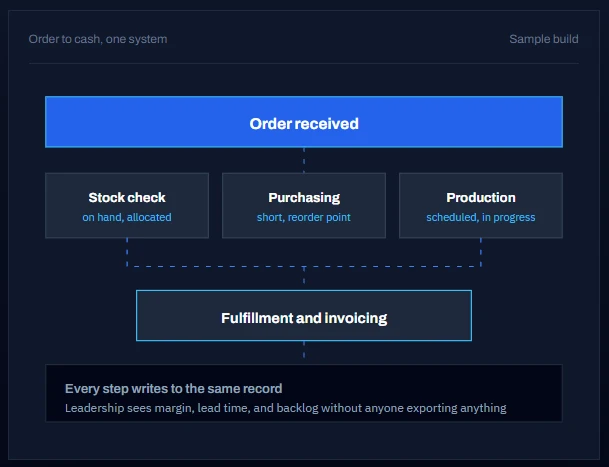
You are probably here because one of these is true.
The master spreadsheet is load bearing
One file runs the company, one person understands it, and everyone is quietly aware of what happens if it breaks.
You cannot trust your inventory count
The system says you have twelve. The shelf says four. Someone drives to a supplier at retail to cover the gap.
Nobody knows job level margin
You know the company made money last quarter. You do not know which jobs, customers, or products actually made it.
Big ERP quoted you six figures
Plus per seat licensing, plus an implementation partner, plus modules for things you will never use.
Your process is the competitive advantage
You do something differently and it is why customers pick you. Off the shelf software would force you to stop.
Growth is capped by coordination
Taking on more volume means hiring another person to chase information between departments, not to do the work.
Only the modules you use.
Inventory and stock
On hand, allocated, and available by location, with lot and serial tracking, cycle counts, and reorder points that actually fire.
Purchasing and suppliers
Purchase orders, supplier pricing, lead times, partial receipts, and a record of who approved what and when.
Production and jobs
Work orders, bills of materials, routing, scheduling, and shop floor status so nobody has to walk the floor to answer a question.
Fulfillment and shipping
Picking, packing, dispatch, carrier handoff, and delivery confirmation tied back to the original order.
Costing and margin
True cost per job, product, and customer, including materials, labor, and the overhead allocation your accountant actually uses.
Dashboards and reporting
Backlog, lead time, fill rate, margin, and whatever number your leadership meeting opens with, current and on screen.
Roles and approvals
Spending limits, approval chains, and an audit trail, so control does not depend on everyone remembering the policy.
Integrations
Accounting, ecommerce, shipping carriers, EDI, and your CRM, so the ERP is the center rather than another silo.
Mobile and floor access
Scanning, receiving, and status updates from a phone or tablet, packaged as a native app with NativePHP where it helps.
Start on QikERP, or build from the ground up.
Built on QikERP
Most common. Typically 2 to 4 months.
We start with our own operations platform and configure and extend it around your workflow, which removes months of foundational work.
-
Faster to launch and lower cost
-
Hosting, security, and updates included
-
Connects to QikCMS and your CRM directly
-
Custom modules built on top as needed
Ground up Laravel build
Fully bespoke. Typically 4 to 8 months.
For operations with unusual data models, regulatory requirements, or a process that is genuinely the reason customers choose you.
-
Architecture designed entirely around your process
-
You own the code and the roadmap outright
-
No per seat licensing, ever
-
Host with us or anywhere you choose
Four phases, and we never big bang it.
Phase 01: Map
We walk the floor, follow an order end to end, and interview the people doing the work. You get scope, budget, and a module order before code.
Phase 02: Prototype
Clickable screens for the first module. Your operators react to real workflows while changes still cost a conversation.
Phase 03: Build and roll
One module at a time into production, each with data migration and training, so the business keeps running throughout.
Phase 04: Extend and support
Hosting, monitoring, and the next module. An ERP is never finished, because the operation keeps changing.
ERP development, answered.
Quoted per project after the mapping phase, because the price depends on how many modules and integrations are in scope. Building on QikERP costs less than a ground up build. There are no per seat licence fees either way, which is usually where enterprise ERP quotes become painful.
They are mature and worth considering. The catch is that you adapt to them, and the customization work to close the gap often costs more than a focused custom build. If one of them genuinely fits your operation, we will say so rather than sell you something you do not need.
No, because we do not switch everything at once. Modules go live one at a time, each running alongside what you use today until your team trusts it. Nobody should be learning a new system during their busiest week.
Yes. Most clients keep their existing accounting package and we sync invoices, bills, and payments to it. We integrate with anything that has a documented API, plus file based transfers where that is the only option.
It comes with you. We map, clean, and import existing records, including the spreadsheets. Migration is part of the build rather than a surprise line item at the end.
You own the code, the database, and the roadmap. For an ERP that matters more than anywhere else, because the system ends up holding how your company works.
Tell us where the operation jams.
-
Response time - one business day, from a developer
-
First call - a working session, not a sales pitch
-
Deliverable - scope, budget, and module order before code
Often built alongside an ERP.
Custom CRM
The front half of the same system: quotes and orders that flow straight into production.
Ordering and ecommerce
Sell online with real stock levels behind it, including B2B accounts and contract pricing.
Mobile app development
Scanning, receiving, and job status from the floor or the truck, on a real native app.