On Roblox, launch day is the start of the work.
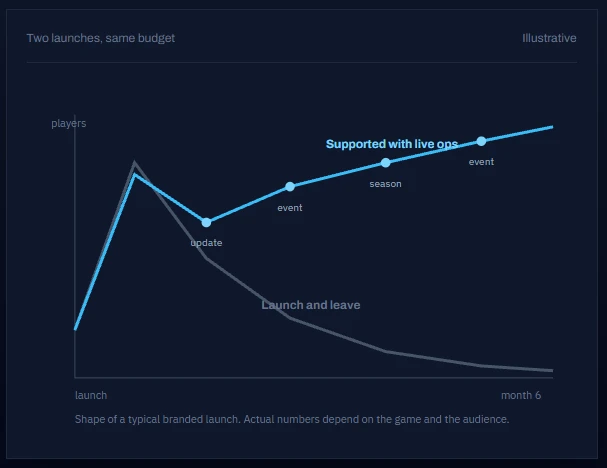
Most branded Roblox experiences get built, launched, and abandoned, and the player count follows. We build the experience and then run it: updates, events, and economy tuning driven by what the data says players actually do.
Sports Scenarios launched a Roblox game and a native mobile app with us from one content product.
You are probably here because one of these is true.
Your audience is already there
Under twenty five, and increasingly not reachable through the channels your media plan is built around.
An ad cannot do what a place can
A fifteen second spot gets skipped. A world people choose to spend twenty minutes inside is a different kind of attention.
You have content that could be a game
Scenarios, trivia, training, or a product experience. Sports Scenarios turned exactly that into both a game and an app.
Your first attempt went quiet
Something launched, got a spike, and then flatlined because nobody was assigned to keep it alive afterward.
You want it to earn
Game passes, developer products, and in game currency, designed so monetization does not wreck the experience.
You need a real partner
Not a freelancer who vanishes at handoff. A studio inside a software company that will still be here next year.
From the first sketch to the tenth update.
Game design
The core loop first. What a player does in the first thirty seconds, why they stay for twenty minutes, and what brings them back on Thursday.
World building
Environments, props, lighting, and UI that carry your brand without turning the place into a billboard players avoid.
Lua scripting
Gameplay systems, server logic, data persistence, and anti exploit work, written to survive a crowd rather than a demo.
Economy design
Currency, rewards, progression, and sinks balanced so the game stays fun and does not inflate into meaninglessness by month two.
Monetization
Game passes, developer products, and cosmetics placed where players want them rather than where they block progress.
Analytics
Session length, retention, funnel drop off, and revenue per player, so the next update is a decision instead of a guess.
Live operations
Seasonal events, limited items, content drops, and a release rhythm players can anticipate.
Moderation and safety
Roblox skews young. Chat handling, reporting, and content controls are treated as a requirement, not a later phase.
Web and app tie ins
Leaderboards, accounts, and rewards connected to your site or mobile app, because we build those too.
A game nobody updates is a game nobody plays.
Roblox rewards activity. The algorithm surfaces experiences that are being updated and played, which means the first month after launch decides more than the six months before it. Budgeting the whole spend on the build is the single most common mistake.
Plan the first ninety days before launch
The first three content drops should be scoped and scheduled before the game goes public, not improvised after the numbers dip.
Keep a share of budget for after
We would rather build a smaller game with six months of support than a bigger one that goes quiet in week three.
Let the data pick the next update
Where players quit tells you what to build next far more reliably than what the room liked in a review meeting.
Give players a rhythm
Regular events and seasons give people a reason to return on a schedule instead of hoping they wander back.
Playable early, and often.
Phase 01: Concept
Audience, core loop, and how your brand fits without feeling like an advertisement. Scope and budget before production.
Phase 02: Grey box
A playable, unpolished version of the loop. If it is not fun without art, more art will not save it.
Phase 03: Production
Art, systems, economy, and monetization built out, with private playtests and load testing before anyone outside sees it.
Phase 04: Launch and live ops
Release, then the content calendar: events, drops, and balance changes driven by retention data.
Roblox development, answered.
Quoted per project after the concept phase, based on scope and how much original art and systems work is involved. The more useful question is total budget including live ops, because a build with no support after launch is money spent on a spike.
A focused branded experience typically runs three to five months from concept to launch. Larger games with deep progression systems run longer. We will give you a date after the concept phase, not before it.
Yes, through game passes, developer products, and cosmetics, with Robux converted out through Roblox. Whether it pays back the build depends on retention, which is why we push so hard on the live ops side. We will not forecast revenue for you before we understand the concept.
Roblox has a young player base and its own platform rules, and we build to those: chat handling, reporting paths, and content controls appropriate to your audience. For a brand this is reputational as much as technical, so it is designed in from the start.
You do. The experience lives under your own Roblox group, and the assets and scripts are yours. Roblox's own platform terms apply on top of that, as they do for everyone publishing there.
Often yes. We audit the existing place and scripts first and tell you honestly whether it is worth continuing or whether a rebuild costs less than untangling it. Either way you get a straight answer before committing.
Tell us who you want to reach.
-
Response time - one business day
-
First call - a working session, not a sales pitch
-
Deliverable - scope, budget, and a live ops plan
Often built alongside a game.
Mobile app development
Sports Scenarios shipped both. One product, two channels, one team building them.
CMS and web platforms
A site behind the game for accounts, leaderboards, merchandise, and news.
Ordering and ecommerce
Sell real world merchandise off the back of an audience you built in game.